The Fassifern Field Naturalists Club Inc. would like to acknowledge the Yugarapul People, the Traditional Custodians of the land on which our Club is founded, and pay our respects to their Elders past and present, their languages, customs, culture and connection to this wonderful country.
Showing posts with label Dugandan. Show all posts

Sunday, 14 June 2020

Hibiscus Harlequin Bugs

 
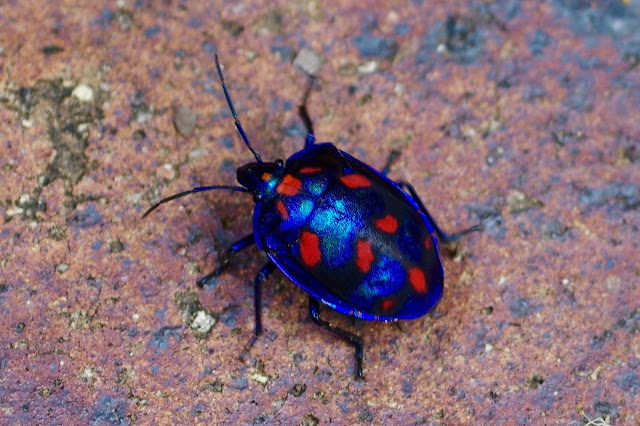
Male Hibiscus Harlequin Bug
Male Hibiscus Harlequin Bug         Photo: A. Podlich

These insects are like miniature Christmas decorations; the males are blue and the females are orange. They are being reported in many places in our area at the moment. Although lovely to look at, unfortunately they are not very lovely in our gardens. They are sap suckers on plants in the family Malvaceae, which includes cotton and hibiscus. They can become a bit of a pest in cotton, giving it an alternative name, Cotton Harlequin Bug. They are also found on Flame Trees (Brachychiton acerifolius) and other brachychitons, grevilleas and bottlebrushes. The females below were on the Native Rosella (Hibiscus heterophyllus) at Teviot Creek, Dugandan.

Female Hibiscus Harlequin Bug    Photo: W. Dunn


Eggs are laid around twigs and the females guard them until they hatch and sometimes after, while they are young instars. 
The Hibiscus Harlequin Bug is found in northern and eastern Australia, New Guinea and some Pacific islands.
Females guarding their eggs

Females guarding eggs     Photo: W. Dunn


 For more photos go to this link. 


Sunday, 22 January 2017

New Butterfly Sighting for Boonah Area

Chaetocneme denitza, Ornate Dusk-flat
Found in a garden in Dugandan in October last year, the Chaetocneme denitza, Ornate Dusk-flat or Rare Redeye, is not often seen.This lovely skipper* was lucky to be found. And it was very lucky that such a brilliant photograph was taken by Joan Kielly for it didn’t hang around for long. The sighting has been confirmed by Wes Jenkinson, a well-known lepidopterist from Beaudesert.

It was found in a typical position for the species, hanging upside down on the underside of a leaf with its wings outstretched. It was on a rose bush but the caterpillars feed on Eucalypts and Lophostemons such as Brush Box and Swamp Mahogany.

The adults are crepuscular: i.e. active during twilight. During the day they usually rest under a leaf. 

Their distribution is from the Qld-NSW border north to Cape York, then west across the top of the Northern Territory and into Western Australia. They are not often seen, as one of their names suggests. In se Qld they fly between October/November and February in open eucalypt forests of coastal and sub-coastal areas.

 (*Although Skipper butterflies share certain characteristics with other butterflies, particularly in egg, larval and pupal stages, they differ in several important ways. They have the antennae clubs hooked backward like a crochet needle, whilst other butterflies have club-like tips to their antennae. Skippers also have stockier bodies with stronger wing muscles. They are named for their quick, darting flight habits. More than 3500 species of skippers are recognised worldwide.)