The Fassifern Field Naturalists Club Inc. would like to acknowledge the Yugarapul People, the Traditional Custodians of the land on which our Club is founded, and pay our respects to their Elders past and present, their languages, customs, culture and connection to this wonderful country.
Showing posts with label Plants. Show all posts

Wednesday, 23 February 2022

Outing Report - Heritage Road, Spicers Gap, 19 February 2022

 
FFNC members on the Heritage Road
Photo: W. Dunn
It was a lovely day; the weather was perfect, the countryside lush, the 
wildlife was wonderful to look at and wonder at, and to top it off, great company. Members and friends ambled along the Heritage Road from the Governor's Chair carpark to the Mt Mathieson Trail junction and back. The photo on the left shows the birding fraternity trying to find the Red-browed Treecreeper. Unfortunately not too many of us saw it before it flew off! 
Bracket Fungi
Photo: L. Beaton


At places it was quite wet underfoot though the track was slashed. It made the cobblestones partially hidden by the grass quite a hazard. Though we marveled at the work needed to build the original road using only hand tools. We read the information boards about the construction while our President explained the geology of the rock. I'm sure we all agreed with Noela that ".... it was just so hard to picture this road being travelled by loaded wagons and coaches probably on tracks no better and even much worse than we were on ....  It really was a very long, dangerous route."
Rock Felt Fern
(Pyrrosia rupestris)
Photo: K. McCosh
Information board about
the construction of the road.
(Perhaps a little update is needed.)
Photo: W. Dunn


We saw a very large Dagger Orchid (Dockrillia pugioniformis). Not in flower thoughWe also noted many Elkhorns (Platycerium bifurcatum) decorating the trees with countless young plants and this Rock Felt Fern (Pyrrosia rupestris) - above right, was loving the wet season.

Another remarkable sighting for the day was a Goanna nonchantly making its way up the track towards us. Eventually it thought it was outnumbered so slowly headed for the thick vegetation at the side of the road and disappeared from view.

For lunch we gathered at the campground day-use area where there was plenty of room to spread out. Here we chatted about what we had seen and what seemed to be missing compared to other visits. The men reported that there were moths in the conveniences! Sure enough, more than a dozen Granny's Cloak Moths (Speiredonia spectans) were hiding in the gloom of the wooden building. One of them had three red mites sucking blood from its wing.
Granny's Cloak Moth (Speiredonia spectans
with the mites
Photos: L. Beaton

 Plague Soldier Beetle
(Chauliognathus lugubris)
Photo: N. Crepin
Fuzzy photo of  Soldier Beetle
(Chauliognathus tricolor),
but it shows the difference
between the two.


Spicers Peak from the Heritage Road
Photo: W. Dunn


Watch this space for the Species lists.

Saturday, 22 January 2022

Outing Report - Shoreline Trail (western end) Lake Wyaralong, 15 January 2022

Two of our members
disappearing into the distance
on the Shoreline Trail
Traditionally our January outing is an early morning bird walk. No matter the weather it always seems popular. This was true this year even with the cloud of the Omicron variant of COVID-19 hanging over us. It was great to see some members who hadn't been on an outing for a while and also to welcome our newest member, Maureen.

Everyone was eager to see plenty of birds. Unfortunately, with the great season we're having most of the water birds have dispersed and few were seen this morning. Even so large flocks of Great and Little Black Cormorants were recorded flying along one arm of the dam. Also, there were many bush birds in evidence. The Dollarbirds and Sacred Kingfishers in particular were very visible and vocal, and Fairy-wrens were in abundance - both the Red-backed and Superb species. 

The exotic Water Hyacinth (Eichhornia crassipes) has started to build up again but the Comb-crested Jacanas and the Striped Marsh Frogs were loving it.

As usual we found far more than birds to catch our attention and a magic morning in the bush was rounded off with a social-distancing gathering at Lilybrook Recreation Area for refreshments in the welcome shade.

Water Hyacinth (Eichhornia crassipes)
in Oaky Creek, Shoreline Trail

2 cicadas found dead on the Trail,
tentatively identified as a Black Prince (left), 
and a Black Tree Ticker (right).

Photographers: W. Dunn, N. Cooper, L. Beaton


Species List for Shoreline Trail Lake Wyaralong

Compiled from members’ sightings by Club Recorder

introduced species = *

Fauna
Birds (72 species): Brown Quail, Black Swan, Australian Wood Duck, Grey Teal, Bar-shouldered Dove, Australian Darter, Little Pied Cormorant, Great Cormorant, Little Black Cormorant, Australian Pelican, White-faced Heron, White-bellied Sea-Eagle, Whistling Kite, Wedge-tailed Eagle, Nankeen Kestrel, Purple Swamphen, Dusky Moorhen, Masked Lapwing, Comb-crested Jacana, Galah, Little Corella, Sulphur-crested Cockatoo, Rainbow Lorikeet, Scaly-breasted Lorikeet, Little Lorikeet, [Australian] King-Parrot, Pale-headed Rosella, Pheasant Coucal, Eastern Koel, Channel-billed Cuckoo, Little Bronze-Cuckoo, Brush Cuckoo,  Laughing Kookaburra, Sacred Kingfisher, Rainbow Bee-eater, Dollarbird, Superb Fairy-wren, Red-backed Fairy-wren, White-browed Scrubwren, Speckled Warbler, Striated Pardalote, Noisy Miner, Brown Honeyeater, White-throated Honeyeater, Blue-faced Honeyeater, Little Friarbird, Striped Honeyeater, Eastern Whipbird, Varied Sittella, Black-faced Cuckoo-shrike, Golden Whistler, Rufous Whistler, Australasian Figbird, Olive-backed Oriole, Grey Butcherbird, Pied Butcherbird, Australian Magpie, Pied Currawong, Spangled Drongo, Willie Wagtail, Torresian Crow, Leaden Flycatcher, Restless Flycatcher, Magpie-lark, Eastern Yellow Robin, Golden-headed Cisticola, Tawny Grassbird, Tree Martin, *Common Myna, Mistletoebird, Red-browed Finch, Chestnut-breasted Mannikin.
 
Amphibians: Striped Marsh Frog, Green Tree Frog.
 
Fish: *European Carp.
 
Butterflies: Fourbar Swordtail (Protographium leosthenes), Lemon Migrant (Catopsilia pomona), Common Grass-yellow (Eurema hecabe), Small Grass-yellow (Eurema smilax), *Wanderer (Danaus plexippus), Lesser Wanderer (Danaus petilia), Common Eggfly (Hypolimnas bolina), Meadow Argus (Junonia villida).
 
Damsel/Dragonflies: Common Bluetail (Ischnura heterosticta), Scarlet Percher (Diplacodes haematodes), Blue Skimmer (Orthetrum caledonicum), Graphic Flutterer (Rhyothemis graphiptera).
 
Other Invertebrates: Ants: Southern Meat Ant (Iridomyrmex purpureus); Beetles; Darkling Beetle sp., Eucalyptus Weevil (Gonipterus sp.), Red-blue Banded Leaf Beetle (Paropsis obsolete); Cicadas; Black Tree-ticker (Birrima varians), Black Prince (Psaltoda plaga).

Spiders: Australian Jewel Spider (Austracantha minax), Leaf-curling Spider (Phonognatha graeffei).
 
 
Flora discussed or taken note of on the day (not a comprehensive list):
Fungi: Termite-mound Fungus (Podaxis beringamensis) – old fruiting bodies.
Aquatic Plants: *Water Hyacinth (Eichhornia crassipes). 

Monday, 1 November 2021

Outing Report - Glen Rock Camp, 15-18 October 2021

FFNC & visitors
in the Casuarina Camping Area
The weekend looked doubtful but the weather forecast assured us it would be fine. So 8 members and 3 visitors braved the conditions and trickled into the Casuarina Camping Area throughout the grey, cloudy Friday. The good spring season had many plants 'springing' into blossom. In the camping area the 
Silky Oaks (Grevillea robusta), Weeping Bottlebrushes (Melaleuca viminalis) and Orange Mistletoe (Dendrophthoe glabrescens) were attracting flocks of birds including all the local lorikeets, Little, Musk, Rainbow and Scaly-breasted. These along with the Little and Noisy Friarbirds meant it was difficult to hear anything else. 65 species of birds were identified over the weekend including a Peregrine Falcon on more than one occasion.
Weeping Bottlebrush and Orange Mistletoe
in the camping area


The forecasts were right and on Saturday we woke to cloudless blue skies. Over the weekend we explored many of the trails with plenty of interesting observations. The plants caught our attention and the Orange Mistletoe was particularly prolific.
The scenery was impressive and many a photo was taken.
Orange Mistletoe
(
Dendrophthoe glabrescens)


The moon in the tall timber


The 'Rock'


A patch of exotic Poppies
(Papaver somniferum ssp. setigerum)


Funnel Ant sp. (Aphaenogaster sp.)

Closer view of Poppy
(
Papaver somniferum ssp. setigerum)
 

Watch this space for the species lists


Wednesday, 21 July 2021

Springtime on Mt French

It might be blowing a gale and the temperature is dropping to under 10°C, but the spring flowers on Mt French are already blooming! Photos taken this week by one of our members, Aub Podlich.

Leucopogon is neoanglicus
Native Sarsaparilla (Hardenbergia violacea)
Bossiaea rupicola

Dusky Coral Pea (Kennedia rubicunda)

Glycine Pea

Wednesday, 19 May 2021

Outing Report - Autumn Camp: Foxbar Falls, Amiens: 14-17 May 2021

The days were bright and warm, while the nights were dark and cool (read cold).
Photo: N. Cooper

Photo: N. Cooper
 
Autumn Greenhood (Pterostylis revoluta)
Photo: N. Crepin

Tall Sundew (Drosera hookeri)
Photo: N. Crepin

Wild Geranium (Pelagonium australe)
Photo: N. Crepin
Guinea Flower (Hibbertia histoidea)
Photo: N. Crepin

Camping at Foxbar Falls Campground
Photo: N. Crepin

White-eared Honeyeater
Photo: C. Bonner
Grey Fantail                                           Photo: C. Bonner

Rock Garden                                           Photo: C. Bonner

Foxbar Falls                                           Photo: C. Bonner
A peaceful morning at Lake Amiens
Photo: L. Oliver

The start of a beautiful day
Photo: L. Oliver
Species lists to come

Wednesday, 2 September 2020

Lilybrook Break - 15 August 2020

Ferns sprouting out of the rock at Lilybrook Break
It was a damp looking morning but still there were twenty members happy to brave the weather. 
Admiring the old Blue Gums

A shower as we started, and a downpour at the end but inbetween was perfect, fine and warm. 

Baby Blue Eyes (Evolvulus alsinoides)
Spring wildflowers were just coming into bloom. 

Fauna species lists:
Birds: Brown Quail, Australian Wood Duck, ,Bar-shouldered Dove ,Australasian Darter, Great Cormorant, Little Black Cormorant, Little Pied Cormorant, Australian Pelican, White-faced Heron, Straw-necked Ibis, White-bellied Sea-eagle, Whistling Kite, Dusky Moorhen, Black-winged Stilt, Masked Lapwing, Sulphur-crested Cockatoo, Little Corella, Long-billed Corella, Galah, Rainbow Lorikeet, Scaly-breasted Lorikeet, Little Lorikeet, King Parrot, Pale-headed Rosella, Little Bronze-cuckoo, Pheasant Coucal, Laughing Kookaburra, Rainbow Bee-eater, Superb Fairy-wren, Red-backed Fairy-wren, White-throated Gerygone, Striated Pardalote, White-throated Honeyeater, Striped Honeyeater, Scarlet Honeyeater, Brown Honeyeater, Yellow-faced Honeyeater, Noisy Miner, Noisy Friarbird, Little Friarbird, Grey-crowned Babbler, Rufous Whistler, Olive-backed Oriole, Pied Butcherbird, Grey Butcherbird, Australian Magpie, Willie Wagtail, Torresian Crow, Magpie-lark, Golden-headed Cisticola, Tawny Grassbird, Silvereye, Welcome Swallow, Double-barred Finch.
Mammals: Eastern Grey Kangaroo
Butterflies: Common Grass-yellow (Eurema hecabe phoebus), Small Grass-yellow (Eurema smilax), Common Eggfly (Hypolimnas bolina nerina).

Sunday, 19 July 2020

When is an apple, not an apple?

Apple galls

On our latest field trip, we came across these funny looking growths on the fresh eucalypt regrowth along the burnt ridge of the Mt Mathieson track. Questions were asked and other than that they were galls made by small insects nothing else was offered.

Recently I've been reading some of our old newsletters and the words of one of our contributors came to me - “…the impulse to know, to want to learn, to discover for one’s self,  .... in other words one gets caught up in the excitement of discovery.” This was me in a box. I wanted to know more about these galls.

Searching the www finds a little information though usually quite academic but I was hooked. I was caught up in the excitement of discovery. 

More apple galls

The type of gall depends on the parasite that produces it. They can be wasps, beetles, midges or something even smaller such as viruses, fungi and bacteria. The insect parasite lays her egg in the plant which forms a protective, woody growth around it. Hence a gall. Psyllids, tiny sap-sucking insects related to lerps, cause galls on native trees. Schedotrioza spp. form distinctive spherical “apple” galls on eucalypt leaves.

Psyllids are approximately 4 mm long and hold their wings roof-like over their bodies and look a little like miniature cicadas. The immature psyllids are specialist feeders, with many species restricted to one plant type or even a single species of plant, and often to particular parts of the plant (leaves, new shoots, etc.) or growth stages (either young or mature foliage). Adults disperse over short distances by jumping or flying, but many species may travel long distances on air currents.

Apple Gall through a Eucalypt leaf

Webliography:

https://www.sciencedirect.com/topics/agricultural-and-biological-sciences/sternorrhyncha

http://oneminutebugs.com.au/gall-inducing-insects/

http://www.dpi.nsw.gov.au/__data/assets/pdf_file/0007/390283/Psyllids-Insect-Pests-of-Eucalypts.pdf

http://www.dpi.nsw.gov.au/__data/assets/pdf_file/0007/390283/Psyllids-Insect-Pests-of-Eucalypts.pdf 

Monday, 6 July 2020

Mt Mathieson Trail Reconnoitre

The leader and I went to check the Mt Mathieson Trail for the July outing on Friday. 

Grasstree spikes on a burnt ridge, Mt Mathieson

It was beautiful weather, warmer than usual for this time of the year. We only went as far as the Lookout, about 2 km. It was upsetting to see how bushfire damaged the area was. A phantom of its former glory. 

Yes, shoots are coming back on the trees and the Xanthorrhoea (grasstrees) are looking healthy but so little canopy and few birds. By the time of our outing the grasstree flower spikes should be fully out. Already some of the early bloomers were attracting bees and butterflies.

Large Grass-yellow on grasstree flower spike

Not all the grasstrees survived however. The one below had this fungi growing on its rotting stem. Don't know which species of fungi it is.
Fungi growing on burnt grasstree
Although fire-ravaged it was a lovely walk with amazing views at the lookout and plenty of birdlife in the thicker scrub. I'm looking forward to our return on Saturday July 18. See previous post for details.

Sunday, 14 June 2020

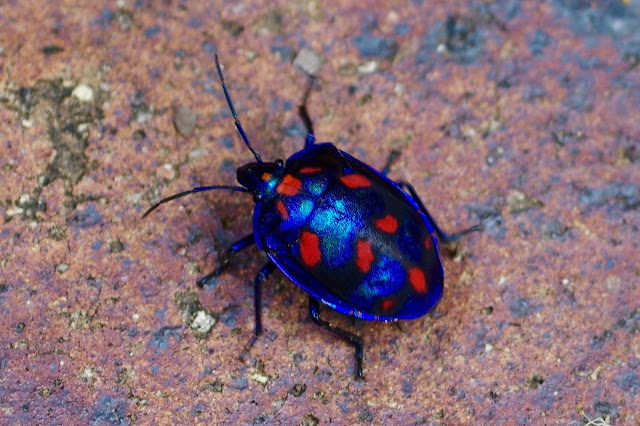
Hibiscus Harlequin Bugs

 
Male Hibiscus Harlequin Bug
Male Hibiscus Harlequin Bug         Photo: A. Podlich

These insects are like miniature Christmas decorations; the males are blue and the females are orange. They are being reported in many places in our area at the moment. Although lovely to look at, unfortunately they are not very lovely in our gardens. They are sap suckers on plants in the family Malvaceae, which includes cotton and hibiscus. They can become a bit of a pest in cotton, giving it an alternative name, Cotton Harlequin Bug. They are also found on Flame Trees (Brachychiton acerifolius) and other brachychitons, grevilleas and bottlebrushes. The females below were on the Native Rosella (Hibiscus heterophyllus) at Teviot Creek, Dugandan.

Female Hibiscus Harlequin Bug    Photo: W. Dunn


Eggs are laid around twigs and the females guard them until they hatch and sometimes after, while they are young instars. 
The Hibiscus Harlequin Bug is found in northern and eastern Australia, New Guinea and some Pacific islands.
Females guarding their eggs

Females guarding eggs     Photo: W. Dunn


 For more photos go to this link.