| Ferns sprouting out of the rock at Lilybrook Break |
| Admiring the old Blue Gums |
A shower as we started, and a downpour at the end but inbetween was perfect, fine and warm.
| Baby Blue Eyes (Evolvulus alsinoides) |
| Ferns sprouting out of the rock at Lilybrook Break |
| Admiring the old Blue Gums |
A shower as we started, and a downpour at the end but inbetween was perfect, fine and warm.
| Baby Blue Eyes (Evolvulus alsinoides) |
![]() |
| Apple galls |
On our latest field trip, we came across these funny looking
growths on the fresh eucalypt regrowth along the burnt ridge of the Mt
Mathieson track. Questions were asked and other than that they were galls made
by small insects nothing else was offered.
Recently I've been reading some of our old newsletters and
the words of one of our contributors came to me - “…the impulse to know, to
want to learn, to discover for one’s self, .... in other words one gets caught up in the
excitement of discovery.” This was me in a box. I wanted to know more about
these galls.
Searching the www finds a little information though usually
quite academic but I was hooked. I was caught up in the excitement of
discovery. More apple galls
The type of gall depends on the parasite that produces it. They
can be wasps, beetles, midges or something even smaller such as viruses, fungi
and bacteria. The insect parasite lays her egg in the plant which forms a protective,
woody growth around it. Hence a gall. Psyllids, tiny sap-sucking insects
related to lerps, cause galls on native trees. Schedotrioza spp. form distinctive spherical “apple” galls on
eucalypt leaves.
Psyllids are approximately 4 mm long and hold their wings roof-like
over their bodies and look a little like miniature cicadas. The immature
psyllids are specialist feeders, with many species restricted to one plant type
or even a single species of plant, and often to particular parts of the plant (leaves,
new shoots, etc.) or growth stages (either young or mature foliage). Adults
disperse over short distances by jumping or flying, but many species may travel
long distances on air currents.
| Apple Gall through a Eucalypt leaf |
Webliography:
https://www.sciencedirect.com/topics/agricultural-and-biological-sciences/sternorrhyncha
http://oneminutebugs.com.au/gall-inducing-insects/
http://www.dpi.nsw.gov.au/__data/assets/pdf_file/0007/390283/Psyllids-Insect-Pests-of-Eucalypts.pdf
The leader and I went to check the Mt Mathieson Trail for the July outing on Friday.
![]() |
| Grasstree spikes on a burnt ridge, Mt Mathieson |
It was beautiful weather, warmer than usual for this time of the year. We only went as far as the Lookout, about 2 km. It was upsetting to see how bushfire damaged the area was. A phantom of its former glory.
Yes, shoots are coming back on the trees and the Xanthorrhoea (grasstrees) are looking healthy but so little canopy and few birds. By the time of our outing the grasstree flower spikes should be fully out. Already some of the early bloomers were attracting bees and butterflies.
![]() |
| Large Grass-yellow on grasstree flower spike |
| Fungi growing on burnt grasstree |
| Moss's Well Track since the 2019 bushfire (Photo taken May 2020) |
April 2011 was the last time the club paid a visit to Spicer’s Gap. Time to revisit this area. We will also check out the fire damage of 2019 and how the bush is recovering.
Time: 8.30am meet – 9am start, 18th July 2020
Where: Spicer’s Gap Picnic Ground (next to the Camp grounds).
Directions: From Boonah drive south on the Maroon/Rathdowney Road for 4 kms and turn right onto the Mt Alford Road and onto Mt Alford. Bear right at Mt Alford, past the school, and drive up the Teviot Range on the Lake Moogerah Road. At 18.7 km from Boonah turn left onto the Mt Edwards/Lake Moogerah Road at the back of the Lake, some of this road is gravel. Continue on the Mt Edward/Lake Moogerah Road for 10.6km then turn left into Spicer’s Gap Road. Drive up Spicer’s Gap Road 7km to Spicer’s Gap Picnic Ground. This road is gravel and is in good condition to Spicer’s Gap Picnic Ground.
For those travelling from Ipswich/Brisbane, head along the Cunningham Highway and 5km after Aratula turn left into Lake Moogerah Road. Drive 5.7km and turn right into Spicer’s Gap Road and continue up to the Spicer’s Gap National Park Picnic Ground.
Features: Rainforest, eucalypt forest, birds, butterflies and other invertebrates, and occasionally koalas can be seen in the area. The Pioneer Graves and Moss’s Well are some of the historical features to view during this expedition.
Activities/Level of Fitness: This is a field trip that should suit everyone. We will walk along part of the Mount Mathieson Trail which is 3.6 km return. There is a longer circuit walk approximately 8.1 km which can be arranged at the time for those who wish to participate in this. For the less energetic, pottering around the area at Spicer’s Gap Picnic area and the Pioneer Graves will bring many delights. This is a nice time to catch up with fellow field naturalists. Lunch will be back at the Spicer’s Gap Picnic Grounds.
Facilities: There are composting toilets at the Picnic Grounds.
What to Bring: Morning tea, snacks, lunch, drinks and chairs. The usual protective gear for a walk including hat, sunscreen, insect repellent, plenty of water for drinking and washing hands, hand sanitizer, camera and binoculars. Good walking shoes are advisable.
Upon Arrival: Please register in the Attendance Book and pay your $2 per person participant fee.
![]() |
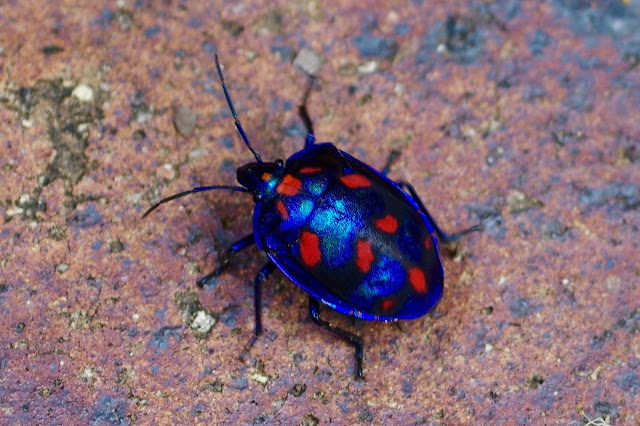
| Male Hibiscus Harlequin Bug Photo: A. Podlich |
These insects are like miniature Christmas decorations; the males are blue and the females are orange. They are being reported in many places in our area at the moment. Although lovely to look at, unfortunately they are not very lovely in our gardens. They are sap suckers on plants in the family Malvaceae, which includes cotton and hibiscus. They can become a bit of a pest in cotton, giving it an alternative name, Cotton Harlequin Bug. They are also found on Flame Trees (Brachychiton acerifolius) and other brachychitons, grevilleas and bottlebrushes. The females below were on the Native Rosella (Hibiscus heterophyllus) at Teviot Creek, Dugandan.
![]() |
Female Hibiscus Harlequin Bug Photo: W. Dunn |
![]() |
Females guarding eggs Photo: W. Dunn |
![]() |
| Male Scarlet Percher, Diplacodes haematodes taken at Mt French. Photo: A. Podlich |
| Female Scarlet Percher, Diplacodes haematodes. Photo: L.Beaton |
![]() |
| Common Archtail, Nannophlebia risi. Photo: L. Beaton |
| Varied Eggfly (Hypolimnas bolina) female Photo: L. Beaton |
![]() |
| Varied Eggfly (Hypolimnas bolina) male Photo: A. Podlich |
| Photo: L. Beaton |
| Cucumber Moth, Diaphania indica |
| Kalbar, EJ ("Kalbar") Smith's patch |
![]() |
| Chris Burwell entertaining the Field Nats |
| Starting out for the water with nets to the ready |
| Plenty of dragonflies here |
| Capturing a damselfly for identification |
| Up close and personal |
Birds: Brown Quail, Plumed Whistling Duck, Australian Wood
Duck, Pacific Black Duck, Crested Pigeon, Peaceful Dove, Bar-shouldered Dove,
Great Cormorant, Little Black Cormorant, Australian Pelican, Whistling Kite,
Wedge-tailed Eagle, Sulphur-crested Cockatoo, Australian King Parrot,
Pale-headed Rosella, Pheasant Coucal, Little Bronze-Cuckoo, Brush Cuckoo,
Laughing Kookaburra, Sacred Kingfisher, Rainbow Bee-eater, Weebill,
White-throated Gerygone, Striated Pardalote, Noisy Miner, Brown Honeyeater,
White-throated Honeyeater, Blue-faced Honeyeater, Striped Honeyeater,
Grey-crowned Babbler, Black-faced Cuckoo-shrike, Cicadabird, Rufous Whistler,
Olive-backed Oriole, Pied Butcherbird, Australian Magpie, Willie Wagtail,
Torresian Crow, Restless Flycatcher, Magpie-lark, Tawny Grassbird, Welcome
Swallow.
Butterflies: Blue Triangle, Orchard Swallowtail, Lemon Migrant, Common
Grass-yellow, Small Grass-yellow, Australian Gull, Caper White, Lesser Wanderer,
Blue Tiger, Common Crow, Meadow Argus, Spotted Grass-blue, Common Grass Blue.
Spiders: Australian Jewel Spider (Austracantha minax).
Damsel/Dragonflies: Wandering Ringtail (Austrolestes leda), Eastern Billabongfly (Austroagrion watsonia), Redtail (Ceriagrion aeruginosum), Aurora Bluetail (Ischnura aurora), Common Bluetail (Ischnura heterosticta), Gold-fronted Riverdamsel (Pseudagrion aureofrons), Blue
Riverdamsel (Pseudagrion microcephalum),
Australian Tiger (Ictinogomphus australis),
Palemouth (Brachydiplax denticauda), Wandering
Percher (Diplacodes bipunctata),
Scarlet Percher (Diplacodes haematodes),
Black-faced Percher (Diplacodes
melanopsis), Water Prince (Hydrobasileus
brevistylus), Blue Skimmer (Orthetrum
caledonicum), Short-tailed
Duskdarter (Zyxomma elgneri).
Moths: Joseph's Coat Moth (Agarista Agricola) 1.
Other Invertebrates: Christmas Beetle (Anoplognathus
porosus), Orange Potter Wasp (Eumenes
latreilli), Cherrynose [cicada] (Macrotristria
angularis).
Amphibians: *Cane Toad.
Reptiles: Red-bellied Black Snake.