The Fassifern Field Naturalists Club Inc. would like to acknowledge the Yugarapul People, the Traditional Custodians of the land on which our Club is founded, and pay our respects to their Elders past and present, their languages, customs, culture and connection to this wonderful country.

Saturday, 25 February 2017

Butterfly Beauty

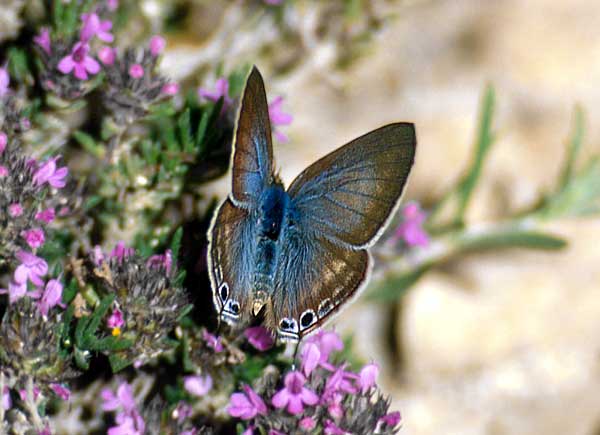
Long-tailed Pea-blue Lampides boeticus, Lake Wyaralong, 22-2-17
(Photo: Aub Podlich)
Butterflies are everywhere in this hot and humid weather. They are wonderful to see. The Fassifern Field Naturalist Club members have recorded at least 58 species of skippers and butterflies in our survey area. 

Some of them are very tiny like this lovely Long-tailed Pea-blue found by one of our members, Aub Podlich, on a recent walk.

This pretty little butterfly is found in all the mainland states, Lord Howe Island and occasionally in northern Tasmania. Also native to Europe, Africa, South Asia and Southeast Asia. They are known to be migratory in Europe. However, even in our own Scenic Rim a massive migration of them was witnessed at Mt Tamborine in 1974. "During August and September vast numbers of butterflies flew south for two weeks ..." . 

The males are a delicate lilac-blue on the upper wings while the females are brown with blue near the body. See this link or this. 

The larva, or caterpillars, feed on legumes such as Sturt's Desert Pea Swainsona formosa, Darling Pea Swainsona galegifolia and garden plants such as peas, green beans and sweet peas.

Bibliography:
"Butterflies of Australia" I.F.B. Common and D.F. Waterhouse, revised edition 1981.
Wikipedia - https://en.wikipedia.org/wiki/Lampides_boeticus
Tree of Life - http://ftp.funet.fi/index/Tree_of_life/insecta/lepidoptera/ditrysia/ papilionoidea/lycaenidae/polyommatinae/lampides/boeticus-3u.jpg
South Australian Butterflies - http://users.sa.chariot.net.au/~rbg/boeticus_ds.htm
APNI - Australian Plant Name Index https://biodiversity.org.au/nsl/services/apniFormat/ display/93060

Tuesday, 14 February 2017

February Outing 2017 - Burnett Creek Rd

Old saw mill area on Burnett Creek Road
This outing will be a leisurely walk around the property of the McKellar’s – up the end of Burnett Creek Road, across Post Box Ford. Standard vehicles should get across the creek but if you are not sure then there will be some 4 wheel drives waiting at the crossing.  When you get across the crossing, go about 1 km to the front gate of the property on the left.  We will all park around here and then walk up the track.  If you get to the old saw mill site and then a locked gate – you have gone a kilometre too far. It takes about 45 minutes from Boonah.

Meet: at the property gate on Saturday 18th February at 8.30 am. 


Bring: Cuppa, morning tea, and lunch.  Lunch back at the cars.  But morning tea out on the track.  Bring the usual stuff – camera, sun screen, insect repellent, walking shoes, water, etc.  Bird books, tree books, reptile books, even butterfly books.

Fitness/Mobility: This is for average mobility.  We walk up a small ridge but it is not too difficult.  Those with less mobility can stay on the road tracks.  We can even drive quadriplegics up the road to the house site – and back again, of course.

Please email us for more information.


Sunday, 22 January 2017

New Butterfly Sighting for Boonah Area

Chaetocneme denitza, Ornate Dusk-flat
Found in a garden in Dugandan in October last year, the Chaetocneme denitza, Ornate Dusk-flat or Rare Redeye, is not often seen.This lovely skipper* was lucky to be found. And it was very lucky that such a brilliant photograph was taken by Joan Kielly for it didn’t hang around for long. The sighting has been confirmed by Wes Jenkinson, a well-known lepidopterist from Beaudesert.

It was found in a typical position for the species, hanging upside down on the underside of a leaf with its wings outstretched. It was on a rose bush but the caterpillars feed on Eucalypts and Lophostemons such as Brush Box and Swamp Mahogany.

The adults are crepuscular: i.e. active during twilight. During the day they usually rest under a leaf. 

Their distribution is from the Qld-NSW border north to Cape York, then west across the top of the Northern Territory and into Western Australia. They are not often seen, as one of their names suggests. In se Qld they fly between October/November and February in open eucalypt forests of coastal and sub-coastal areas.

 (*Although Skipper butterflies share certain characteristics with other butterflies, particularly in egg, larval and pupal stages, they differ in several important ways. They have the antennae clubs hooked backward like a crochet needle, whilst other butterflies have club-like tips to their antennae. Skippers also have stockier bodies with stronger wing muscles. They are named for their quick, darting flight habits. More than 3500 species of skippers are recognised worldwide.)

Thursday, 12 January 2017

January Outing 2017 - Early Morning Bird Walk

Knehr Rd - western end of Lake Wyaralong
Fassifern Field Naturalist members
at Lake Wyaralong (in winter.)

Date: 21st January 2017

Arrive: 6 am – the best time to catch the birds and beat the heat.

Upon arrival, please register by signing the Attendance Book and pay the $2 per person participation fee.

Directions from Boonah: drive along the Ipswich/Boonah Road for approximately 7 km and turn right onto the Beaudesert/Gold Coast Road, drive 4.4km then turn left onto Old Beaudesert Road (western end). Drive 0.6kms then turn right onto Knehr Road. Drive 0.9km and then turn right, follow this section of road which goes over a flood causeway for another 0.9 km. Turn right again and follow the track down to the gate at the western end of the trail and dam. Meet here.

Directions from Beaudesert: Look for the Old Beaudesert Road turn off just towards the end of the new section of the Beaudesert/Boonah Road (approximately 28 km from Beaudesert). Turn right here and follow the instructions above.
Knehr Road is gravel, some small hills and winding parts to the road, however suitable for 2-wheel drive vehicles except after heavy rain. Check with us closer to the day of the field trip if concerned.

Level of Fitness: The Shoreline Track is not strenuous and is classified as easy by seqwater. The track is regularly maintained and gently undulating. 

Bring: morning tea (or breakfast), chair, snacks, drinks, binocs, camera, hats and plenty of sun screen and insect repellent.  

Monday, 21 November 2016

Outing Report - Insect Symposium, November 2016

We had a great time. Thanks to Peter and Barry for organizing the symposium.

Trays of water insects

Insects under the microscopes

Lunch in the shed

Friday, 4 November 2016

November Outing - Insects Symposium

The November outing, Saturday 19th, is an opportunity to learn a little more about the insects in our area. This is to be held at a private property so please check your newsletter for details. Otherwise contact us through our blog email: fassifernfieldnaturalists[at]gmail.com.

Our respected member, Barry, will open up the fascinating world of insects and also provide members and guests with the opportunity to inspect different insects up close with the aid of microscopes.

Members are encouraged to bring along any insects, photos and stories about insects (or anything else) to share with everyone present. 

It is also a social time for members to catch up after their travels. Come for morning tea, and stay to be entertained.

Don’t forget your cameras, insect repellent (to get the critters for further research!!!)
Moths, or ....

.... bees, or ....

.... beetles. Whatever takes your fancy.

Goomburra National Park - October camp

Due to the number of members away on their own adventures, it was a small group of Field Nats who gathered at Manna Gum campground. However we still had a great time on our walks and around the campfire.

The camp in the cool morning
Red-necked Pademelon just outside the caravan door
Field nats photographing massive fungi
on the Mt Castle Lookout track


Paper Daisy on the Winder Track
Tangled vines on the Sylvester's Lookout track

Sunday, 18 September 2016

Outing Report - Flagstone Creek, Coochin, September 2016

After the preliminaries and a short chat on the area, we walked up the track to an internal fence line where Keith spoke of the geology of the area and the work he has done with the local landholders through the Scenic Rim Regional Council.  Des spoke of the early days of a local family growing crops for sale on top of the hills near a cliff line, which is accessed up Black Rock Road. Des and John used to live immediately west of this area in their younger days and Des gave us an interesting chat on the people and pursuits of the area while we had our lunch. Around 43 birds were recorded on the day as well as other fauna and plenty of interesting flora. 


The floodplain of Flagstone Creek, Coochin
Tiny webs glistening in the morning dew
A web close up
Mt Asplenium to Spicer's Peak (left to right)
Dogwood (Jacksonia scoparia) and Leptospermum variabile
Round Ant Eater (Omoedus orbiculatus)
Keith with Rusty Pomaderris (Pomaderris ferruginea) and Leptospermum variabile
Clambering up the rock face
Species List: compiled by the Club Recorder from members’ sightings.
Beetle: Variable Ladybird (Coelophora inaequalis)
Birds: Peaceful Dove, Bar-shouldered Dove, Wedge-tailed Eagle, Rainbow Lorikeet, Musk Lorikeet, Australian King-Parrot, Pheasant Coucal, Shining Bronze-Cuckoo, Laughing Kookaburra, Rainbow Bee-eater, Red-backed Fairy-wren, White-browed Scrubwren, White-throated Gerygone, Spotted Pardalote, Lewin's Honeyeater, Yellow-faced Honeyeater, Scarlet Honeyeater, Brown Honeyeater, White-throated Honeyeater, Blue-faced Honeyeater, Noisy Friarbird, Little Friarbird, Striped Honeyeater, Black-faced Cuckoo-shrike, Rufous Whistler, Grey Shrike-thrush, Australasian Figbird, Grey Butcherbird, Pied Butcherbird, Australian Magpie, Pied Currawong, Grey Fantail, Torresian Crow, Leaden Flycatcher, Eastern Yellow Robin, Golden-headed Cisticola, Silvereye, Welcome Swallow, Mistletoebird, Double-barred Finch, Red-browed Finch.
Butterflies: Lesser Wanderer (Danaus chrysippus), Wanderer (Danaus plexippus).
Damselflies: Wandering Ringtail (Austrolestes leda); immature male – a pale tan colour, and adult male - blue.
Dragonflies: Scarlet Percher (Diplacodes haematodes); one male, Black-faced Percher (Diplacodes melanopsis); one male.
Moth: Triangular Moth (Epidesmia chilonaria).
Skink: Wall Skink (Cryptoblepharus virgatus).
Spiders: Wolf Spider sp., Round Ant Eater (Omoedus orbiculatus).
Evidence of species: Orts (food scraps) only - Glossy Black-Cockatoo, bandicoot diggings – possibly Northern Brown Bandicoot (Isoodon macrourus), scats only Koala (Phascolarctos cinereus), wallaby tracks - unknown species.

Flora (just some that were discussed on the walk): On the floodplain soil – Moreton Bay Ash (Corymbia tessellaris), Grey Gum (Eucalyptus punctata), Small-leaved Fig (Ficus obliqua), Black Tea-tree or River Tea-tree (Melaleuca bracteata) with mistletoe that attracted the Mistletoebird, Yellow-faced Honeyeaters, and a Shining-bronze Cuckoo. On the rocky slopes – Smooth-branched Ironbark (Eucalyptus dura), Queensland Peppermint (Eucalyptus exserta), Cheese Tree (Glochidion ferdinandi), Dogwood (Jacksonia scoparia), Leptospermum microcarpum - no common name, Brush Box (Lophostemon confertus), Rusty Pomaderris (Pomaderris ferruginea). 

Tuesday, 13 September 2016

September Outing - Flagstone Creek, Coochin Coochin

A gathering of Field Nats, at the last outing. See you at Flagstone Creek.
Meeting Place:  Park your cars 50 metres inside the gate at 1719 Boonah-Rathdowney Road which is on the left going south from Boonah. There will be a marker put in place before the flood-way sign just before Flagstone Creek. (If you go through Flagstone Creek causeway then you’ve gone too far.)

Time:  8.30 am for a 9.00 am start. Upon arrival, please register in the Attendance book and pay the $2 per person participation fee.

Level of Fitness: Another outing for everybody. This field trip is on level knee-high grassland and a creek bed of flattish rock with a gentle upward slope.  Two barbed wire fences need to be negotiated. We’ll see the local birds, flora, fauna, insects, butterflies and the Scenic Rim in the western distance.

Planned Activities: We’ll walk a vehicle track initially – go along a fence line to the creek then along the side of the creek on the northern side which should be good for seeing the birds – through a barbed wire fence then along the side of the creek again and on another track to the bed of the creek. –this could be the morning tea stop – then “up the creek” on flattish rock with some careful stepping on some slippery areas – through the fence across the creek and up a little further until we junction with another creek – from there on it gets a little too rough with no real benefit for us. When we come out of the creek on the way out, we’ll take a slightly different route after we’ve gone back through the barbed wire fence. The trip should be around 2.5 km.

Carry morning tea with you and we’ll return to the vehicles for lunch. There are no after lunch plans so we could take our time and have a late lunch.

We have permission from the three landholders.

What to bring: Morning tea, lunch, water, binocs, cameras, and your favourite repellents & sunscreens.  Also your tables and chairs for lunch.

Thursday, 8 September 2016

Outing report - Secret Valley, June 2016

Saturday's walk: the red path being outbound while some members took the higher, green path back to the cars.
It was a beautiful day for the June outing: warm with no wind and a clear blue sky making it ideal for walking in the bush. The track to the valley is 2.5 kilometres of the Shoreline Trail on the northern side of the lake. We spent a little time at the Eastern Trailhead car-park where we saw plenty of birds along the dam wall and in the car park, and an unusual fungi in the garden bed.
Birdwatching in the eucalypt woodland

The winding track beside the lake is gently undulating and passes through mixed eucalypt woodland. The Spotted Gums (Corymbia maculata) were in flower and the groundcover, Winter Apple (Eremophila debilis), was fruiting. 

No frogs, lizards or mammals were seen on the day, however our fauna list totalled 50 species of birds and one butterfly. 

BIRD LIST FOR SECRET VALLEY 
Brown Quail, Australian Wood Duck, Pacific Black Duck, Hardhead, Australasian Grebe, Common Bronzewing, Bar-shouldered Dove, Australasian Darter, Great Cormorant, Little Black Cormorant, Australian Pelican, Eastern Great Egret, Intermediate Egret, White-faced Heron, White-bellied Sea-Eagle, Whistling Kite, Brahminy Kite, Dusky Moorhen, Eurasian Coot, Masked Lapwing, Rainbow Lorikeet, Scaly-breasted Lorikeet, Little Lorikeet, Australian King-Parrot, Azure Kingfisher, Laughing Kookaburra, Superb Fairy-wren, Red-backed Fairy-wren, Variegated Fairy-wren, Striated Pardalote, Yellow-faced Honeyeater, Noisy Miner, Scarlet Honeyeater, Brown Honeyeater, White-throated Honeyeater, Noisy Friarbird, Black-faced Cuckoo-shrike, Golden Whistler, Rufous Whistler, Australian Magpie, Grey Fantail, Willie Wagtail, Torresian Crow, Restless Flycatcher, Magpie-lark, Jacky Winter, Tawny Grassbird, Silvereye, Welcome Swallow, Australasian Pipit. 
BUTTERFLY: Wanderer.