The Fassifern Field Naturalists Club Inc. would like to acknowledge the Yugarapul People, the Traditional Custodians of the land on which our Club is founded, and pay our respects to their Elders past and present, their languages, customs, culture and connection to this wonderful country.
Showing posts with label Fassifern Field Naturalists Club Inc.. Show all posts

Saturday, 6 June 2026

June Outing Details - Rabbit Fence & Queen Mary Falls, 20 June 2026

Admiring the magnificent trees
along the Rabbit Fence
Time: 8:30 am

Where: Rabbit Fence on Spring Creek (The Head) Rd.

Directions: About 40 minutes from Boonah. 
From Boonah head south and get onto Carney’s Creek Road and then get onto The Head Road, signposted as the 'The Falls Drive' and 'Queen Mary Falls' (about 29kms from Boonah). Go right to the top, past Teviot Falls, and over the gap and down into the Condamine River valley. Wilson’s Peak will be on your left. The Rabbit Fence meets the road about 5kms past the Falls. There are places to park here.

Activities: We will take a short stroll along the rabbit fence to check out the giant Brush Box trees, and maybe hear Lyrebirds calling. This is an area of big trees, so wherever you look will be fascinating. There is lots to see just walking along the road. Then we check out some groves of eucalypt trees further down the valley – Manna Gums and New England Blackbutt. Stop off at Carr’s Lookout for a lookout. And then down to Queen Mary Falls for a short walk to see the falls and then lunch. It is winter but there will still be lots of birds.

Level of Fitness: Easy if you stay on the tracks. To cross into NSW you have to climb a gate but there's plenty to see on the Queensland side of the fence.

Facilities: Toilets at Boonah and Queen Mary Falls (and Killarney). Picnic tables at Queen Mary Falls.

What to Bring: 
Morning tea and lunch. Chairs, water and other stuff. 
It could be cold. 

Upon Arrival: Please register in the Attendance Book and pay your $2 per person participant fee. 


April Outing Report - Shed Day, 18 April 2026

 Adapted from the FFNC newsletter article of P & T Shields.

Dr Christina Zdenek addressing the members

The afternoon commenced with quiz on bird identification but with a twist – only parts of each bird were visible for people to use for identification. A great deal of amusement and comments were made.

Dr Christina Zdenek followed with an extremely interesting talk on how certain kinds of rat poisons are killing our owls (and eagles, quolls, and pets) and what Birdlife Australia is doing to try and stop that.
The second-generation rodenticides are
banned from public sale in many countries (e.g. USA, Canada, EU and Malaysia) but not in Australia. Birdlife Australia believes that widespread public use of long-lasting second- generation rodenticides is killing wildlife on a major scale and is focused on preparing submissions to the Federal regulator as well as campaigning secondary targets such as retailers.

Following a break for afternoon tea, one of our members, B Jahnke, presented a thought-provoking talk on “Educating the public”. He compared the syllabus for secondary education in biology in the 1980s with the current Queensland syllabus, highlighting the major differences and wondering aloud whether current students are obtaining the fundamental knowledge and principles to study biology (i.e. understand our living world).
His talk stimulated much discussion and gave us all some thoughts to consider into the future.
Nothing better than a convivial chat
around a fire.


As dusk came some of us convened to the “waterway” to enjoy an evening meal and bonfire.


Friday, 1 May 2026

February Outing Report - West Gap Creek, Cunningham’s Gap 21 Feb 2026

Adapted from the FFNC newsletter report by M. See. (Photos by Club members)
Natters along the track
at West Gap Creek

Eleven enthusiastic natters gathered on a beautiful mild February morning at West Gap Creek car park.
The grassy glade of the picnic area shaded by tall eucalypts, yielded a host of birds right off, both seen and heard including the musk lorikeet and the white-throated honeyeater. Crossing the creek with its helpful bolted flat rocks, we headed off in groups on a ramble along the Box Forest track which rises gently and follows the creek and finishes 2.5km later at the Crest carpark where the majestic hoop pines are found. 
We only ventured part of that distance although 90 minutes passed quickly, as there was so much to see, discuss, photograph and wonder over, especially the huge brush box trees around us as we got further up the track and the diversity of flora all around us.
Although most of the group wandered back when morning tea was calling them, a few intrepid types continued for a short distance and were rewarded when an Albert’s lyrebird strode across the track in front of them. It seemed unperturbed by their presence as it proceeded to scratch in the leaf litter about 10m from the track while they attempted in vain to capture its photo.
We then all gathered for a most welcome morning tea in the large picnic shelter which accommodated us all nicely and compared notes before heading down into the creek area to examine the aquatic life. We were pleased to find a school of mountain galaxias, in the clear, deep pools a small fish that thrives in locations such as this where introduced fish are absent. We also delighted in spotting the strikingly huge tadpoles of the barred frogs (either Fleay’s barred frog or the great barred frog) camouflaged well against the rocks and taking an occasional trip to the surface for air.

Flora (discussed or taken note of on the day, not a comprehensive list) 
Introduced species = *
Groundcovers, Low Shrubs, Epiphytes and Vines: wombat berry Eustrephus latifolius, flax lily Dianella sp., lomandra Lomandra longifolia, cunjevoi Alocasia brisbanensis, bird’s nest fern Asplenium australasicum, rough maidenhair fern Adiantum hispidulum, giant maidenhair fern Adiantum formosum, prickly rasp fern Blechnum neohollandicum, bracken fern Pteridium esculentum, gristle fern Blechnum cartilagineum, dwarf sickle fern Pallaea nana, tender brake Pteris tremula, Pyrrosia sp., elkhorn fern Platycerium bifurcatum, pollia Pollia crispata, pencil orchid Dockrillia sp., native grape Apocissus antarctica, giant water vine Apocissus hypoglauca, native yam Dioscorea transversa, settler’s flax
Gymnostachys anceps, stinging nettle Urtica incisa, barbwire vine Smilax australis, snake vine Stephania japonica, bower of beauty Pandorea jasminoides, tall sedge, Carex appressa, scurvy weed Commelina cyanea, kidney weed Dichondra repens, blady grass Imperata cylindrica, weeping
grass Microlaena stipoides, common tussock grass Poa labillardieri, forest hedgehog grass  Echinopogon nutans, Australian bluebell Wahlenbergia gracilis, stout-rooted wood-sorrel Oxalis radicosa.
Shrubs: 
native raspberry Rubus rosifolius, broad-leaf bramble Rubus moluccanus, bush lawyer Rubus moorei, poison peach Trema tomentosa var. aspera, red-fruited palm lily Cordyline rubra, hairy  psychotria Psychotria loniceroides, tie bush Wikstroemia indica, cockspur thorn Maclura  cochinchinensis, bolwarra Eupomatia laurina, kangaroo apple Solanum aviculare, wild tobacco *Solanum mauritanium, lantana *Lantana camara.
Trees: brush box Lophostemon confertus, pink bloodwood Corymbia intermedia, grey gum (possibly Eucalyptus biturbinata) rose she-oak Allocasuarina torulosa, native tamarind Diploglottis australis, giant stinging tree Dendrocnide excela, strangler fig Ficus sp., creek sandpaper fig Ficus coronata, muttonwood Rapanea variabilis, wattle Acacia sp., yellow pittosporum Pittosporum revolutum, celerywood Polyyscias elegans, bleeding heart Homalanthus populifolius, white bolly gum Neolitsea dealbata, Bangalow palm Archontophoenix cunninghamiana, pink poplar Euroschinus falcatus, tallowwood Eucalyptus microcorys, black booyong Argyrodendron actinophyllum, orange boxwood
Mountain Galaxias,
Galaxias olidus
Denhamia disperma.

Fauna
introduced species = *
Amphibians & Reptiles: Frogs; tadpoles of either or both the great barred frog Mixophyes fasciolatus and Fleay’s barred frog Mixophyes fleayi.
Birds: – (H) = heard only.
brown cuckoo-dove, wonga pigeon (H), azure kingfisher, musk lorikeet, little lorikeet (H), rainbow lorikeet, Albert's lyrebird, satin bowerbird, white-throated treecreeper, variegated fairy-wren, white-naped honeyeater, white-throated honeyeater, Eastern spinebill (H), Lewin's honeyeater, bell miner, spotted pardalote, brown gerygone (H), white-browed scrubwren (H), yellow-throated scrubwren, golden whistler, Eastern whipbird (H), cicadabird(H), pied currawong (H), grey fantail, black-faced monarch (H), Torresian crow, rose robin (H), Eastern yellow robin, double-barred finch.
Fish: mountain galaxias Galaxias olidus.
Marsupials: red-necked pademelon Thylogale thetis.
Butterflies: blue triangle Graphium sarpedon, orchard swallowtail Papilio aegeus, wanderer *Danaus plexippus, yellow admiral Vanessa itea.
Other Invertebrates: Worms: leech Chtonobdella sp.

Autumn Camp Details - CANCELLED! Members check your emails for alternative arrangements

Main Beach, Iluka
Photo: Wikipedia, Public Domain
Dates: 15th-18th May 2026

Where: Iluka, Northern NSW

Directions: It is about 150 kms south of the border – go past Brunswick Heads, into Ballina, then Woodburn, and travel about 36kms past Woodburn and turn left into Iluka - before you go over the Clarence River and hit Maclean.
Alternatively, you could do the scenic route through Rathdowney, and Kyogle and Casino to Woodburn.

Activities: We are meeting up with our old friend Janet Hauser. There is a rainforest next to town that Janet is very familiar with. There are beaches with a few headlands. Also Bundjalung National Park is nearby – with all sorts of different habitats, including coastal heath, and
there is the Clarence River.
Grafton, Maclean and Yamba are not far away for individual, optional visits.
It’s a beautiful and relaxing spot.

What to Bring: 
It might be a bit cooler. It could rain. It could be warm enough for a
swim. Sand flies and mosquitos may be present. So be prepared. And start saving for extra fuel
costs now. 
Suitable clothing and footwear for walking in the bush, sunscreen, and the usual naturalist stuff of your choice; binoculars, camera, field guides, notebook, etc.

Upon Arrival: Please register in the Attendance Book and pay your $2 per person participant fee.

More information:- Members: see your newsletter. Non-members: please contact fassifernfieldnaturalists@gmail.com.

Saturday, 7 March 2026

March AGM Details - Boonah – Saturday, 21st March 2025

Lost Koala, Boonah High Street

Where: The Conference Room at ‘The Outlook’.

Time:  2 pm for 2.15 pm start.

Directions: Coming into Boonah along the Boonah-Ipswich Road, just when you come over the hill and get your first view of Boonah with the Scenic Rim mountains as a backdrop, you will see the big ‘Welcome to Boonah’ sign on the left. Turn left just before the sign and immediately left again, proceed up the steep hill to the carpark. Park, get out, turn around and take in the view! Signs will direct you to the Conference Room.

Admission: $4 per person.

Agenda: Reports for 2025 year and voting on Executive positions for 2026.

AGM Formalities: Club officers will give reports on Club matters to the Club Members. Office bearers for 2026 will be elected. And upcoming events will be highlighted. Then on to the guest speaker and afternoon tea.

Guest Speaker: Lara Solyma, biodiversity officer for Scenic Rim Regional Council, on “Koalas of the Fassifern”.
Lara is part of the environmental team at Scenic Rim Regional Council. She will talk about conservation initiatives for the Koala in the wider Fassifern area. Surveys have been conducted and DNA samples collected. Koala family trees give us clues to how Koalas are using the forests of the Fassifern.

Bring Display Items: Any interesting objects, or photos, or information on the incredible diversity of fauna and flora in the Fassifern and even SEQ. Bring questions too.

Members: Please bring a plate of goodies. Coffee and tea provided.

It is also time to pay your annual membership fee for 2026. Peter, our Treasurer, will be on hand to receive your payment or you can pay on line – details for online payments are on the Information page of our Newsletters.

Wednesday, 1 October 2025

October Camp Details - Myall Park Botanic Garden, Glenmorgan – 17th-20th October 2025

Lagoons at Myall Park entrance
Photo: L. Beaton
Where: Myall Park Botanic Garden, 7km north of Glenmorgan

Activities: 
Friday 17th - arrive as preferred, bird walk at 4pm for early arrivals, at 6pm an info session and Birdcall.
Saturday 18th - morning and afternoon walks at Myall Park Gardens property with siesta around midday, Birdcall at 6pm. 
Sunday 19th – walk at Eringibba National Park. Enringibba is a 20min drive southeast with park entry at the southern boundary off Windermere Road.
Lunch at the Glenmorgan Hotel for those interested and afternoon at leisure. Birdcall at 6pm. 
Monday 20th – departure at your convenience.

Non-members, please contact fassifernfieldnaturalists@gmail.com for more information.  
Members, please refer to your September newsletter. 

Wednesday, 10 September 2025

September Outing Details - Spicers Gap, Saturday 20th September 2025

FFNC at Spicers Gap in 2022
Photo: L. Beaton
Time: 
8:30 am

Where: Spicers Gap day-use area, near the campground, and opposite the mango farm.

Directions: Directions-Route A: From the Dugandan Pub (0kms) - head south and take the Mt Alford turnoff (right turn). Go through Mt Alford and on to Moogerah – up over the ridge on Mt Alford Road. At 28kms turn left into Lake Moogerah Road and the sign says to Mt Edwards. Go over Reynolds Creek bridge and on some good dirt until 38kms -turn left into Spicers Gap Road. There is bitumen for 3kms and then about 4kms of good dirt, but steep in places. 
Directions-Route B: alternate route. Get onto Cunningham Highway and travel south through Aratula for about 5kms and turn left into Lake Moogerah Road. Travel about 5kms until you hit Spicers Gap Road on the right.

Activities: Spring will have sprung. There will be birds and butterflies everywhere. It is a while since we went there last - 2022. The bush has come back a lot more since those fires of 2019. There are tall forest areas and rainforest pockets. There are tracks and roadsides –all reasonably flatish. There is even a spring-fed well (Moss’s Well). For those who want to walk a lot there is the Mt Matheson Track or the old road.  
We will stay up in the mountains for lunch. We might hang-around the campground for a bit; up the Matheson Track for a short distance; Moss’s Well and road for a bit; and maybe Governors Chair for a bit.

Level of Fitness: As easy or as strenuous as you like, your choice. 

Facilities: Picnic tables, toilet.

What to Bring: suitable clothing and footwear for walking in the bush, sunscreen, insect repellent, safety stuff, water, morning tea and lunch, chair, and the usual naturalist stuff of your choice; binoculars, camera, field guides, notebook, etc.

Upon Arrival: Please register in the Attendance Book and pay your $2 per person participant fee. 

July Outing Report - Sherwood Arboretum & Oxley Common, Saturday 21 June 2025

Adapted from the FFNC August 2025 newsletter report by K. McCosh
Little Pied Cormorant
Photo: FFNC member
A warm winter’s day greeted us at the Sherwood Arboretum for a city-based outing to a place I hadn’t seen for ages. Barry showed us around and gave some background to the Arboretum. It is quite a historical place. An “arboretum” is a place devoted to trees. This arboretum was certainly full of trees, with two rows of big old Kauri Pines down the middle. Various specimen trees had been planted across the site – some exotic but mostly Australian natives. 

The site is a low-lying creek area next to the Brisbane River, so it goes under water often. A small lagoon provides great habitat for waterfowl, but no rarities were seen today. We could hear dingoes howling at one time. I don’t think dingoes live in the revegetated creek bank area, that the western suburbs branch of SGAP has worked hard on. I hope it was from Lone Pine Zoo, at Fig Tree Pocket, just across the river from Sherwood. 

Milky Mangrove
Photo: Wikipedia under Creative Commons Licence
https://creativecommons.org/licenses/by-sa/4.0/
The rainforest is regenerating nicely, under some big old Blue Gums. It even has a Scrub Turkey. Along the river, three species of mangrove can be found – River Mangrove Aegiceras corniculatum, Milky Mangrove Excoecaria agallocha, and Yellow Mangrove Ceriops tagal. Some were covered in buds, and about to explode into flower. This area is about the limit of salinity but it is still very tidal. 

In one of the gardens we sighted a couple of Bush Stone-curlews. How can such a big bird be almost invisible? They seemed to be happy here and didn’t mind lots of people in the park. 

After a walk around the park, we headed over to the Oxley Creek Common on Oxley Creek. Picnic tables and a shelter shed make this area a popular place for Brisbane-ites. There is also a track that goes along the creek for a few kilometres. Lots of birds along this track. Lots of bushcare and tree planting too – the local Bushcare group have restored quite an extent of riparian habitat. They have even established some Berry Saltbush Einadia hastata as a thick groundcover. After lunch and a walk we all headed home. 

SPECIES LIST: Muscovy Duck (Domestic type), Australian Wood Duck, Pacific Black Duck, Hardhead, Australian Brush-turkey, Spotted Dove, Crested Pigeon, Buff-banded Rail, Dusky Moorhen, Australasian Swamphen, Bush Stone-curlew, Australasian Grebe, Little Pied Cormorant, Little Black Cormorant, Australian White Ibis, Striated Heron, Plumed Egret, Laughing Kookaburra, Galah, Sulphur-crested Cockatoo, Pale-headed Rosella, Scaly-breasted Lorikeet, Rainbow Lorikeet, Noisy Miner, Brown Honeyeater, Blue-faced Honeyeater, Striated Pardalote, Eastern Whipbird, Grey Butcherbird, Pied Butcherbird, Australian Magpie, Pied Currawong, Willie Wagtail, Grey Fantail, Torresian Crow, and Welcome Swallow. 

June Outing Report - Cotswold Road, Maroon, Saturday 21 June 2025

 Adapted from the FFNC July 2025 newsletter report by K. McCosh
Mt Maroon in the clouds
Photo: L. Beaton
Twenty intrepid members of the FFNC Club nearly got swept up into the crush of climbers going up Mt Maroon. There was even a bus load of Irish tourists! There’s a joke there somewhere. All looking for a parking spot amongst the trees of this very interesting Vine Scrub. All intent on getting to the top – somewhere up in the clouds. 

Mt Maroon is a very busy place these days. But we managed to see some big (and therefore old) scrub trees – such as Crow’s Ash and Leopard Ash. Older trees generally have smaller leaves, and those big Crow’s Ash trees had very small leaves. There were lots of smaller trees and shrubs – many with small or spikey leaves that are typical of “Dry” scrubs that dry out from time to time. Some Brush Teak Toechima tenax was impressive, being larger than most. This patch of Dry Vine Scrub is a remnant of much bigger scrubs around the mountain. 

There was also a natural dam there with reeds etc. How did that get there? Mt Maroon began as a rhyolite intrusion into the huge Focal Peak Volcano some 20 million years ago. Most of the volcano has eroded away down to the older sandstone layers, leaving tougher rocks exposed. The Cotswolds are old sandstones and rhyolite intrusions and basalt bits and pieces. 

The birds were a bit quiet, but considering the busy-ness of the place, they were more abundant than expected. One big ironbark tree on the edge of the scrub was just “full” of birds. Silvereye, Lewin’s Honeyeater, Yellow-faced Honeyeater, Golden Whistler, Grey Fantail, Varied Triller and Rose Robin were all there. We had a delightful morning tea picking out the birds in this tree. A mystery butterfly with two distinctive white spots on a black background near the wing tip gradually went from being a Caper Gull to a Yellow Albatross – a colourful sighting. Noela with the eyes of an eagle saw it perched in thick vegetation!

Species Lists for Cotswold Road, June 2025 
introduced species = *
Amphibians & Reptiles: *Cane Toad Rhinella marina – 1 dead.
Birds: Pacific Black Duck, Australasian Grebe, Shining Bronze-Cuckoo, Black-shouldered Kite, Dusky
Moorhen, Australian King-Parrot, Laughing Kookaburra, Rainbow Bee-eater, White-throated Treecreeper, Satin Bowerbird, Superb Fairy-wren, Red-backed Fairy-wren, White-browed Scrubwren, Brown Gerygone, Spotted Pardalote, Striated Pardalote, Eastern Spinebill, Lewin's Honeyeater, Yellow-faced Honeyeater, Brown Honeyeater, White-throated Honeyeater, Eastern Whipbird, Black-faced Cuckoo-shrike, Varied Triller, Golden Whistler, Rufous Whistler 􈄥􍿸 & 􈄥􍿷, Grey Shrike-thrush, Pied Currawong, Grey Fantail, Willie Wagtail, Torresian Crow, Jacky Winter, Rose Robin, Silvereye (some being the Tasmanian subspecies Zosterops lateralis, Double-barred Finch, Australasian Pipit.
Marsupials: Red-necked Wallaby. 
Butterflies: Black Jezebel Delias nigrina, Yellow Albatross Appias paulina, *Wanderer Danaus plexippus, Evening Brown Melanitis leda.

Friday, 27 June 2025

July Outing Details - Sherwood Arboretum & Oxley Common, Saturday 21 June 2025

Kauris at Sherwood Arboretum
Photo: L. Beaton

Time: 9 am

Where: Sherwood Arboretum on Jollimont Street, Sherwood, Brisbane

Directions: Follow the Ipswich Motorway in towards Brisbane and take a left exit into Fairfield Road at Rocklea. Then left into Sherwood Road and out past the Markets and over Oxley Creek and across Oxley Road, and over the railway line (near Sherwood Station). At a T-section at the end of Sherwood Road, turn left into Dewar, and then right into Jollimont. Down the street a bit, and you are there. More information here.

Activities: A guided tour (by one of our Brisbane members) of some of the features of this historic place. It is a 15 hectares heritage-listed park. We are just dipping our toe into what the Arboretum has to offer. There are several walking trails, and over the past 20 years, some 170 bird species have been recorded in the park. After morning tea we will travel back to the Oxley Creek Common along Sherwood Road (just over the Oxley Creek bridge). Walks along the creek, birds, trees and then lunch.

Level of Fitness: Easy walking. Tracks are flat.
Sherwood Arboretum
Photo: L. Beaton

Facilities: toilets, picnic tables etc.

What to Bring: binoculars for birds, etc., chairs, morning tea, lunch, water and suitable walking shoes.

Upon Arrival: Please register in the Attendance Book and pay your $2 per person participant fee. 

Camp Report - Leslie Dam – 16-18th May 2025

 Adapted from the FFNC June 2025 newsletter report by I. Reynolds

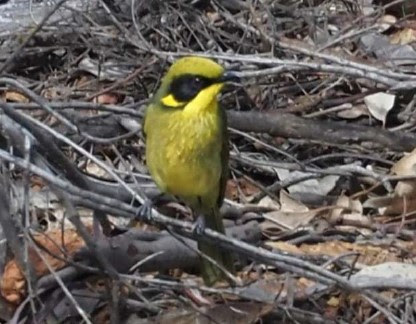
Yellow-tufted Honeyeater at Durakai
Photo: I. Reynolds
At least some brave souls ignored the weather forecast and settled in at Lake Leslie Tourist Park on Friday afternoon. There was 38mm of rain overnight, brightening up by Saturday, although still cloudy.

Before the camp proper a couple of early campers were fortunate to watch an Australian Hobby vigorously plucking some unfortunate small bird in a dead tree near the Lake.

Durakai State Forest was our first call, and  walking along one of the tracks, we encountered a birding ‘hot spot’ centered around a small puddle of water. Many Fuscous, Brown, Yellow-faced, Yellow-tufted and White-eared Honeyeaters were bathing, as well as Yellow Robin, male Golden Whistler, and Grey Fantail amongst others.

Later a look at the dam wall at Lake Leslie gave us excellent views of 2 Osprey perched on a rail. A walk along the edge of the Lake and surrounding bushland in the afternoon gave us another decent species list. Out on the lake were at least 1,000 Eurasian Coot, many Darters and a cluster of 40 Australasian Grebe as well as the usual Pelicans, Cormorants, etc.

Scaly-breasted Munia at Allora Mountain
Photo: Yathin S Krishnappa
Creative Commons Attribution-Share Alike 3.0 Unported
On our way home on Sunday, four of us called in at Allora Mountain Flora and Fauna Reserve, a very interesting area with a steep climb to the top. There was lots of privet that the local Allora Landcare group are trying to eradicate. The couple last to leave had an unexpected bonus, a dozen Scaly-breasted Munia, aka Spice Finch or Nutmeg Manikin, sighted near the area where we had recorded Yellow-rumped Thornbill and Double-barred Finch.

A great weekend in great company.

Bird Species Lists
Lake Leslie – north side (40 sp.)
Australian Wood Duck-12, Pacific Black Duck-4, Grey Teal-4, Crested Pigeon-8, Dusky Moorhen-20, Eurasian Coot-1000, Australasian Swamphen-2, Pied Stilt-2, Masked Lapwing-2, Australasian Grebe-40, Australasian Darter-8, Little Pied Cormorant-4, Little Black Cormorant-12, Pied Cormorant-4, White-necked Heron-1, Great Egret-1, Australian Pelican-20, Osprey (Australasian)-2, Laughing Kookaburra-2, Australian Hobby-1, Galah-15, Little Corella-80, Sulphur-crested Cockatoo-10, Australian King-Parrot-2, Red-winged Parrot-1, Eastern Rosella-4, Red-rumped Parrot-8, Musk Lorikeet-2, Superb Fairywren-6, Noisy Miner-10, Blue-faced Honeyeater-6, Striped Honeyeater-2, Grey-crowned Babbler-2, Grey Butcherbird-1, Australian Magpie-6, Pied Currawong-4, Willie Wagtail-2, Magpie-Lark-6, Apostlebird-12, and Torresian Crow-6.

Durikai State Forest (25 sp.)
Little Lorikeet-4, White-throated Treecreeper-2, Brown Treecreeper-1, Yellow-faced Honeyeater, Yellow-tufted Honeyeater-2, Noisy Miner-2, Fuscous Honeyeater-12, Brown Honeyeater-1, White-eared Honeyeater-2, Striped Honeyeater-2, Noisy Friarbird-1, Striated Pardalote-4, Weebill-8, Grey Shrikethrush-2, Golden Whistler-2, Rufous Whistler-2, Grey Butcherbird-1, Willie Wagtail-2, Grey Fantail-3, Australian Raven-4, Rose Robin-2, Jacky Winter-1, Eastern Yellow Robin-1, Welcome Swallow-2, and Mistletoebird-1.

Allora Mountain Flora & Fauna Reserve (22 sp.)
Crested Pigeon-3, Black-shouldered Kite-1, Superb Fairywren-8, Noisy Miner-2, Striated
Pardalote-2, Weebill-3, Yellow-rumped Thornbill-7, White-throated Gerygone-1,
Black-faced Cuckooshrike-2, Golden Whistler-2, Rufous Whistler-1, Australasian Figbird-2, Grey Butcherbird-1, Australian Magpie-4, Pied Currawong-2, Willie Wagtail-1, Magpie-lark-1, Restless Flycatcher-2, Torresian Crow-4, Jacky Winter-1, Double-barred Finch-6, and Scaly-breasted Munia-12.

Sunday, 13 April 2025

April Outing Details - Shed Social, Saturday 26 April 2025

Though this shed may be a bit too far away
for our meeting
 
Time: 2 pm for 2.30pm start

Where: Please contact us

Activities: Trips, adventures, socializing, a lot of laughter 
and a bonfire.

  • We have three members who will give illustrated talks on their travels.
  • As always, the floor is open to anyone to talk about any subject you would like to share or you can show us items of interest - there will be a display table available for showing items.

We expect the presentations to end around 5pm.

Facilities:  a fridge for food is available. 
There are plenty of chairs though none have side tables.

What to Bring: Your own drinks, afternoon tea and dinner (plus plates, cups, cutlery, etc.) if you would like to stay for socializing around the bonfire.

Upon Arrival: Please register in the Attendance Book and pay your $2 per person participant fee. 

Sunday, 13 October 2024

October Camp Details - Girraween National Park – 18th- 20th October 2024

If you're lucky,
you may see the
Phebalium whitei
Photo: https://en.wikipedia.org/wiki/Phebalium_whitei
Non-members: Please contact fassifernfieldnaturalists@gmail.com for more very important details such as cost, booking sites, etc.

Members: Please check your September newsletter for more important details as above

Where: Castle Rock Camping Area in Girraween National Park. This area has sites for both vans and tents. If you don’t want to camp please check out some of the nearby cabin and cottage accommodation options, or motels in Stanthorpe.

When: 18th – 20th October. 

Getting there: Girraween National Park is approximately a 30 minute drive south of Stanthorpe. Take a signed left hand turn off the New England Highway 26km south of Stanthorpe, and follow a windy bitumen road to the park entrance. The road name is Pyramids Rd. Castle Rock campground is 300 metres on from the information centre. 

Google tells me it is approximately 180 km from Boonah, and takes a little over 2 hours to get there.

Things to do: HEAPS! Enjoy exploring the beauty of the granite landscape with its balancing boulders, streams, and the rich diversity of fauna and flora. 

Girraween is an Aboriginal word which means “Place of Flowers”, and at this time of year there should be plenty out. There are a lot of different walks of varying difficulty from 30 minute strolls along well graded tracks, to as challenging as you would like. Or just find a quiet place to sit and enjoy the surroundings. 

Tuesday, 28 March 2023

2023 AGM

Snare's Crested Penguins
Photo: L. Oliver
Linda enjoying the below 0° weather
with some mates
Photo: N. Crepin


Our AGM was well attended as usual. The formal business was dealt with quickly and we got onto the highlight of the evening -
"Macquarie Island and the Sub-Antarctic Islands of New Zealand 
- and the adventure there and back"
presented by Linda Oliver. The heat of Queensland was forgotten as we became engrossed in the landscape and wildlife of these remote and blizzard-swept islands. We were amazed at how close she could get to the penguins, albatross, and parrots (Yes, parrots in the Antarctic!)

View over Macquarie Island bluffs
(with a small view of King penguins
on the beach below)
Photo: M. Murphy - in the Public domain


Royal Penguins
Photo: L. Oliver


This was followed by a brief account by Keith McCosh of a project highlighting the once vast Rosewood Scrub to our north.

Keith explaining the expanse
of the Rosewood Scrub
Photo: N. Crepin
P.S. The usual gang was re-elected except for a Secretary, Linda resigning from that position. However a replacement has stepped forward since the AGM!